Part 2: Dog Cruciate Ligament Surgery in the UK: Procedures, Costs, and Home Recovery
November 24, 2026

Is Your Dog Limping? Find Out If Cranial Cruciate Ligament Surgery Can Help
- 20 Nov 2026
- 6 days ago

3 days back, my receptionist received a call from a teenage boy who wanted to book an appointment for his dog. He explained that his dog had started limping on one of its back legs and was finding it difficult to walk normally.
The boy was living away from home for his studies, while his grandmother was looking after the dog. Since she was alone at home and could not easily bring the dog to the clinic straight away, he wanted to arrange an online consultation first. He hoped to understand what might be causing the limp and what steps they should take next.
After hearing his situation, I instructed my receptionist to arrange an online appointment according to my schedule. We connected at 3 p.m. sharp that same day.
As soon as we joined the call, the boy greeted me by name and introduced himself. He explained that he had heard about me through the mother of one of his friends, who knew me as a veterinary surgeon at Bluebell Veterinary Surgery in Southampton. He had contacted me because he wanted professional advice about his dog’s condition.
During our conversation, he explained that his grandmother had noticed the dog limping on one of its back legs. The dog had also stopped showing interest in playing with the children from the neighbourhood, something it usually enjoyed.
I started by asking a few questions to understand the situation better. How long had the dog been limping? Had it slipped, fallen, or injured itself while playing? Was the limp getting better or worse? Had his grandmother given the dog any medication?
The boy answered as best he could, although he admitted that he did not know every detail because he was living away from home. Even so, his answers gave me some useful information about the dog’s condition.
Based on what he described, a cranial cruciate ligament injury was one of the possibilities I wanted to investigate. However, I did not want to jump to conclusions or suggest a diagnosis without examining the dog properly.
I could understand that the boy was worried, especially because he could not be at home to look after his dog himself. So, I reassured him that there was no need to panic and explained that the next step was to arrange a proper veterinary examination. I asked him to speak with his grandmother and arrange for someone to bring the dog to our clinic so I could assess its leg and understand what was causing the limp.
A limp in a dog’s back leg is often linked to the cranial cruciate ligament—an essential stabiliser inside the knee joint. Before narrowing everything down to a single ligament, though, it helps to look at what your dog’s walk is telling you, how to keep them comfortable at home, and how a hidden knee problem can quietly develop behind the scenes.
Why Is Your Dog Limping?
Watching your dog hobble across the living room or hesitate at the back door is always worrying—whether you spot it yourself at home or hear from a family member that your dog isn’t walking normally. Before focusing on one specific knee condition, vets always step back to look at the whole picture first. Lameness isn’t a diagnosis on its own; it is simply your dog’s instinctive way of shifting weight away from a sore, weak, or unstable limb.
Sometimes the culprit is as minor as a tiny piece of grit wedged between the toes. Other times, it points to a deeper joint, bone, or soft-tissue problem that benefits from prompt care. Observing which leg your dog is favouring and how their daily habits have shifted gives us our very first diagnostic clues—and helps you make sense of what your dog is trying to communicate.
Why Is Your Dog Limping on Its Back Leg? Common Causes to Know
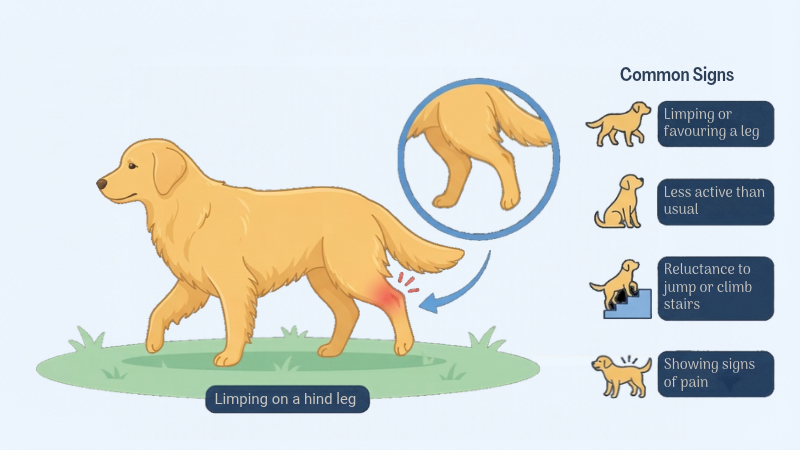
Hind-leg limping is something I examine almost every day in the consult room. Alongside sneaky paw injuries like split claws or trapped grass seeds, the most frequent culprits sit higher up inside the knee (which vets call the stifle joint) and the hip.
In adult dogs, cranial cruciate ligament problems, slipping kneecaps (patellar luxation), hip dysplasia, and age-related joint wear are common reasons a back leg starts to falter. Muscle strains in the thigh or lower back discomfort can also change how smoothly your dog pushes off from behind, which is why a calm, hands-on examination is essential before jumping to conclusions.
Why Is Your Dog Limping on Its Front Leg?
If your dog is favouring a front paw instead, their walk will tell a noticeably different story. Dogs carry roughly 60% of their body weight through their front legs, so forelimb soreness often shows up as a distinct “head bob”—your dog’s head lifts up just as the sore paw touches the ground to lighten the load.
Common causes include shoulder tendon strains, elbow dysplasia in growing or large breeds, wrist sprains from landing awkwardly out of the car boot, and bruised paw pads. Watching closely how your dog carries themselves helps narrow down where the soreness sits, yet many owners still feel puzzled when their pet seems bright and unfazed in every other way.
“But They Aren’t Crying!” – Why Dogs Limp Without Showing Pain
One of the biggest myths in pet care is that a dog in pain will yelp, whine, or cry out. In reality, dogs are remarkably stoic animals wired by instinct to mask vulnerability, and the limp itself is the sign of discomfort.
Rather than vocalising, an uncomfortable dog will simply adapt quietly—walking a little slower, sleeping more than usual, or suddenly losing interest in playing outside and joining in with everyday neighbourhood fun. Even if your dog is still wagging their tail and eating dinner enthusiastically, pulling back from favourite games and altering their gait is their body’s honest way of protecting a tender area.
Why Is Your Dog Limping but Still Putting Weight on Its Leg?
Not every injury causes a dog to hold their paw right up off the ground. Mild sprains, early joint inflammation, or a partially frayed ligament often allow a dog to keep getting around the house while placing noticeably less pressure through that paw.
You might only catch this subtle, weight-bearing lameness when your dog first rises from a long snooze or trots across hard garden paving. There is no need to panic when you spot a gentle hobble, as catching a limp early puts you in a strong position to help them heal—especially when you know the safest first steps to take at home.
What Should You Do If Your Dog Is Limping?
When you first notice a limp—particularly if you cannot get down to the clinic straight away and need a little time to arrange transport or a convenient appointment—your priority at home is keeping the leg rested and preventing further strain. Start by keeping your dog calm and pausing their usual walks for the day. Provided your dog is relaxed and happy for you to handle the limb, gently check their paw pads, between the toes, and around each nail for grit, thorns, cuts, or swelling.
Until a vet has assessed the leg properly, simple house rules go a long way. Keep garden toilet breaks strictly on a short lead, block access to stairs, and lift your dog carefully—or use a steady ramp—rather than letting them jump onto the sofa or into the boot of the car. Hold off on giving any household tablets from your own medicine cabinet, and if the limp lasts longer than 24 hours or keeps returning after exercise, book one of our first-opinion veterinary consultations so a vet can examine the limb safely.
While many mild strains and gradually developing joint niggles can wait comfortably while you organise a daytime visit, certain warning signs mean your dog needs much faster help.
How to Know If Your Dog’s Limping Is Serious?
Whenever I speak with worried owners ahead of an examination, one of the first things we establish is whether the leg can wait safely for a routine slot or requires urgent, same-day care. Please contact a vet straight away if you spot any of these red flags:
- Non-weight-bearing lameness: Your dog holds the paw completely off the floor and refuses to touch it down at all.
- Visible swelling or heat: A joint or limb looks noticeably puffed up, feels hot to the touch, or sits at an odd angle.
- Sudden distress or lethargy: Your dog is trembling, panting heavily at rest, running a fever, or turning away from their food.
- Dragging or knuckling: The top of the paw scrapes along the pavement as they walk, which can point to a spinal or nerve issue.
- Open wounds or bleeding: You spot deep cuts, heavily bleeding broken claws, or suspect sudden trauma from a bad fall or road accident.
Once urgent emergencies like fractures or deep wounds are ruled out, many owners assume a lingering back-leg limp must simply be a pulled muscle. Yet in everyday clinical practice, one specific orthopaedic condition inside the knee stands out above almost all others.
Can a Cruciate Ligament Injury Be the Reason Your Dog Is Limping?
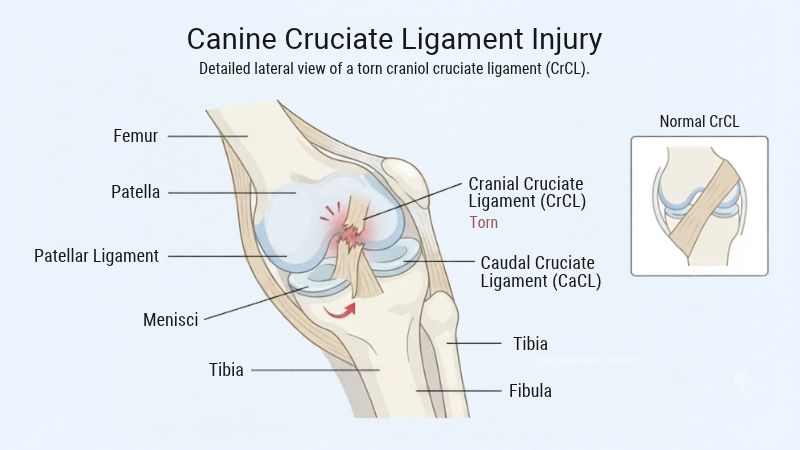
Yes—in veterinary medicine, cranial cruciate ligament disease is the single most common cause of hind-leg lameness in dogs. Whenever an owner tells me their dog pulled up lame after a run in the park, or has developed a nagging back-leg hobble that leaves them reluctant to play at home, the knee is one of the very first places I check.
An analysis of 171,522 dogs across English primary-care practices conducted through the Royal Veterinary College VetCompass programme estimated an annual diagnosis prevalence of 0.56%, confirming it as an everyday reality in UK clinics. Understanding why this particular ligament causes so much trouble starts with a quick look inside your dog’s knee.
What Is a Cranial Cruciate Ligament Injury in Dogs?
Inside your dog’s knee (stifle) joint, two tough, fibrous bands of tissue cross over each other in an ‘X’ shape to connect the thigh bone (femur) above to the shin bone (tibia) below. The band sitting towards the front is called the cranial cruciate ligament (CCL).
Every time your dog puts weight on their back leg, this ligament performs two vital jobs: it stops the shin bone from sliding forward out from underneath the thigh bone, and it prevents the knee from twisting excessively inwards. When those fibres fray or snap, the joint loses its anchor and the bones subtly shear against one another with each step, triggering painful inflammation across two typical stages:
- Partial tear: Only some of the ligament’s fibres have frayed, causing mild or on-and-off lameness that often worsens after busy walks or garden play.
- Complete rupture: The entire ligament snaps through, leaving the knee physically unstable and usually causing a sharp, sudden worsening in your dog’s limp.
Many owners recognise the human equivalent—the anterior cruciate ligament (ACL), famous for side-lining footballers. However, there is a crucial anatomical difference: humans stand upright on straight legs with a relatively flat shin-bone top, whereas dogs stand permanently with their knees bent on a backward-sloping shin surface (tibial plateau). Because of that natural slope, a dog’s CCL stays under constant tension on every single step—even while pottering quietly around the house.
What Causes Cruciate Ligament Injuries in Dogs?
Whenever I ask an owner whether their dog slipped, fell, or twisted awkwardly before the limp started, many feel baffled because they never witnessed a dramatic accident—while others feel guilty over an ordinary game in the garden. Unlike human ACL tears caused by a sudden tackle or ski fall, canine orthopaedic specialists—including researchers at Cornell University’s Riney Canine Health Center—note that most canine cruciate injuries build up silently through slow wear and tear over months or years:
- Gradual degeneration: Microscopic collagen fibres weaken over time; peer-reviewed orthopaedic research shows that once joint inflammation sets in, 85% of affected knees progress to a full rupture.
- Sudden awkward movements: Jumping for a frisbee, skidding on wet grass, or twisting sharply during play often acts only as the “final straw” on an already weakened ligament.
- Excess body weight: Extra weight strains the knee daily; VetCompass data found dogs heavier than average for their breed had 3.4 times the odds of CCL diagnosis than leaner breed-mates.
- Genetics and bone shape: Inherited traits—such as overly straight back legs or a steeper slope at the top of the shin bone—increase mechanical pull on the ligament with every stride.
- Age and neutering status: Across 1,000 UK VetCompass cases, average diagnosis age was 7.4 years; dogs aged 6 to 9 faced 3.2 times the risk of under-3s, and neutered dogs 1.4 to 1.5 times that of entire females.
Understanding that gradual, hidden wear is behind most tears is often a huge relief for caring owners who worry a single walk caused the injury—and because inherited build plays such a strong role, certain dogs visit our consult room with knee trouble far more often than others.
Which Dog Breeds Are More Prone to Cruciate Ligament Injuries?
Any dog—from a tiny crossbreed to a giant guardian—can injure their cruciate ligament, yet UK research highlights clear breed patterns. In the Royal Veterinary College study comparing purebreds against crossbreeds, Rottweilers carried the highest risk at 3.66 times, followed closely by Bichon Frises (2.09 times) and West Highland White Terriers.
As also noted in PDSA’s veterinary guidance on cruciate ligament disease, other breeds we routinely treat include Labrador Retrievers, Golden Retrievers, Newfoundlands, Staffordshire Bull Terriers, and Boxers. Large breeds tend to develop symptoms at a noticeably younger adult age than small terriers and toy breeds, too.
Whether your dog is one of these predisposed purebreds or a much-loved Heinz-57 cross, knowing the tell-tale everyday clues helps you spot knee trouble early—even before you step into the clinic.
What Are the Signs and Symptoms of a Torn Cruciate Ligament in Dogs?
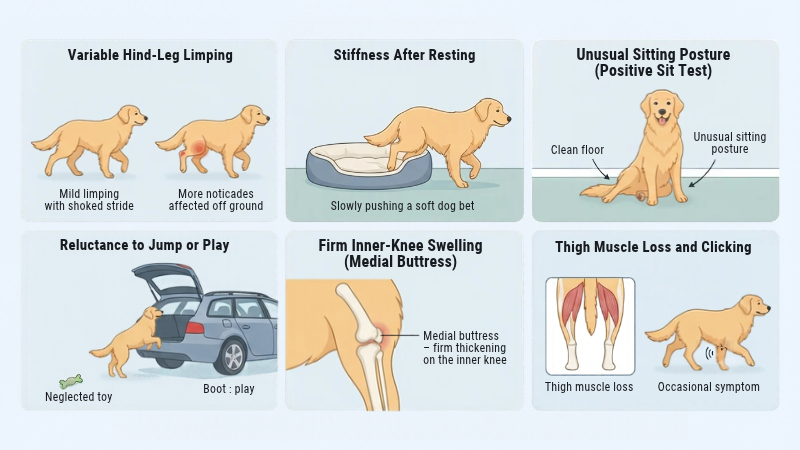
Cruciate disease rarely looks identical from one dog to the next. Some pets wake up slightly stiff for weeks before suddenly lifting a hind leg after a garden dash, while others simply slow down and stop joining in with games they normally adore. Keep an eye out for these classic clues at home:
- Variable hind-leg limping: Anything from a subtly shortened stride after walks to holding the back paw completely off the ground.
- Stiffness after resting: Struggling to push up smoothly from their bed, especially first thing in the morning or the evening after exercise.
- An unusual sitting posture: Known to vets as a positive sit test, dogs avoid bending the sore knee fully and kick that back leg awkwardly out to one side.
- Reluctance to jump or play: Hesitating before hopping into the car or climbing stairs, or quietly pulling back from energetic play with children and family.
- Firm inner-knee swelling: Scar tissue builds up along the inside edge of the shin bone to brace the joint, creating a firm bump vets call a medial buttress.
- Thigh muscle loss and clicking: Over several weeks, the injured leg’s thigh muscles look thinner than the healthy side, and you may hear a faint click as they walk.
When several of these signs match what your family is seeing at home, bringing your dog in for an unhurried clinic examination replaces worried guesswork with clear answers.
What Should You Do If Your Dog Shows These Signs?
If you have noticed some of these changes in your dog’s walking, sitting or everyday activities, it is worth arranging a veterinary examination. A dog with a cruciate ligament injury may still be able to walk, play a little or put weight on the affected leg, but that does not mean the knee is functioning as it should.
As a veterinary surgeon, I, Wojciech Woszczyński, always encourage owners to get a persistent limp checked rather than trying to work out the cause themselves. A proper examination helps us understand the condition of the knee and decide what care may be appropriate.
You may now be wondering what happens if your dog is diagnosed with a torn cruciate ligament. Does every dog need an operation? Which surgical procedure is suitable? How much does it cost in the UK, and how long will your dog need to recover?
There is quite a lot to explain, so rather than rush through these important questions, I’ll cover them in a separate second part of this blog.
In Part 2: Dog Cruciate Ligament Surgery in the UK: Procedures, Costs, and Home Recovery, we’ll look at the different surgical options, including TPLO, TTA and extracapsular repair. We’ll also discuss the costs involved, what happens during surgery and how you can support your dog throughout recovery at home.
So, if your dog has been diagnosed with a cruciate ligament injury, continue with Part 2 to understand what treatment and recovery may involve.

Is Your Dog Limping? Find Out If Cranial Cruciate Ligament Surgery Can Help
November 20, 2026
How Is Pancreatitis in Dogs Treated, and Does It Require Surgery?
November 10, 2026
What Happens During Dog Tumor Removal Surgery?
November 6, 2026