Part 2: Dog Cruciate Ligament Surgery in the UK: Procedures, Costs, and Home Recovery
November 24, 2026

Part 2: Dog Cruciate Ligament Surgery in the UK: Procedures, Costs, and Home Recovery
- 24 Nov 2026
- 19 hours ago
A few days after the afternoon video consultation I shared in Part 1: Is Your Dog Limping? Find Out If Cranial Cruciate Ligament Surgery Can Help, the teenage boy I had spoken with arrived at Bluebell Veterinary Surgery in Southampton – this time alongside his grandmother and their much-loved dog.
As I welcomed them into the consult room, I could see straight away how eager they both were for clear answers. The boy had been worrying from afar ever since first hearing about the limp, while his grandmother had been looking after their dog at home and quietly watching those changes in everyday movement up close.
Once our patient had settled in with a gentle fuss, I began by asking how things had gone since our online chat. Had resting at home eased the back-leg limp at all? Was the dog still finding it awkward to push up from bed or walk comfortably across the garden? And had there been any spark of interest in joining the neighbourhood children for games again?
After listening closely to everything they had noticed, I carried out a calm, hands-on examination of the affected hind leg. To understand the condition of the knee clearly—without natural muscle tension masking any joint movement—I also recommended taking diagnostic X-rays under light sedation.
For both grandmother and grandson, this was a reassuring turning point. They had come into the clinic hoping to finally pinpoint why their dog was struggling to walk, and naturally, their thoughts quickly turned to what could be done to get their companion comfortable, steady, and enjoying everyday life again.
Once we had assessed the stifle joint and confirmed a cranial cruciate ligament injury, we sat down together to talk through the next steps in plain, unhurried English. I explained that there are several proven surgical techniques used to stabilise cruciate injuries in dogs—most notably TPLO, TTA, and extracapsular repair. Each procedure restores stability in its own way, and choosing the most suitable approach always comes down to the individual dog’s build, bodyweight, and joint assessment.
At the same time, I knew medical terms were only half of what the family needed from me. They also had very natural, practical questions about the cost of surgery here in the UK, what operation day actually involves, and—especially with his grandmother overseeing daily routines at home—what supporting their dog through recovery would realistically look like afterwards.
These are the exact questions almost every caring owner asks when a cruciate ligament injury is confirmed. So, let’s step through them together – starting with a clear look at the different surgical options and what each procedure involves.
How Is a Cruciate Ligament Injury Diagnosed in Dogs?
While an initial chat gives us valuable background clues, diagnosing a cruciate tear properly is a gentle, hands-on detective process in the consult room. I always begin by listening closely to your dog’s full story – how the limp started, whether rest helps, and how they are managing stairs, garden steps, and daily routines at home.
Next comes a calm physical and orthopaedic examination. After watching how your dog walks and trots outside or along our corridor, I gently feel down the spine, hips, knees, and paws to check for joint fluid, warmth, thigh muscle wastage, or that firm thickening along the inner knee.
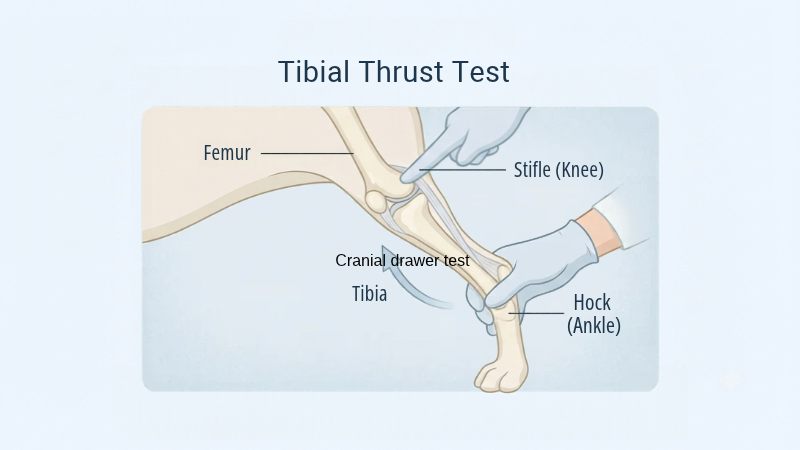
To assess the ligament’s stability directly, vets use two specialised biomechanical checks:
- Cranial drawer test: Holding the thigh bone steady with one hand, we gently check whether the shin bone slides forward further than normal—much like opening a small drawer.
- Tibial thrust test: Flexing the ankle (hock) while resting a finger over the front of the knee reveals whether the shin bone shifts forward abnormally under simulated weight-bearing.
Because worried or well-muscled dogs naturally tense their thigh muscles in the consult room, they can easily mask mild instability while wide awake. Giving a light, safe sedative allows your dog to relax peacefully so we can repeat those gentle checks accurately while taking diagnostic X-rays.
Although the ligament itself is soft tissue and invisible on a standard X-ray, radiographs are essential: they reveal excess joint fluid, early arthritic changes, and the exact shin-bone angles needed to plan surgery, while ruling out fractures or bone tumours. In subtle early partial tears, advanced imaging such as ultrasound, MRI, CT, or keyhole arthroscopy may occasionally be recommended.
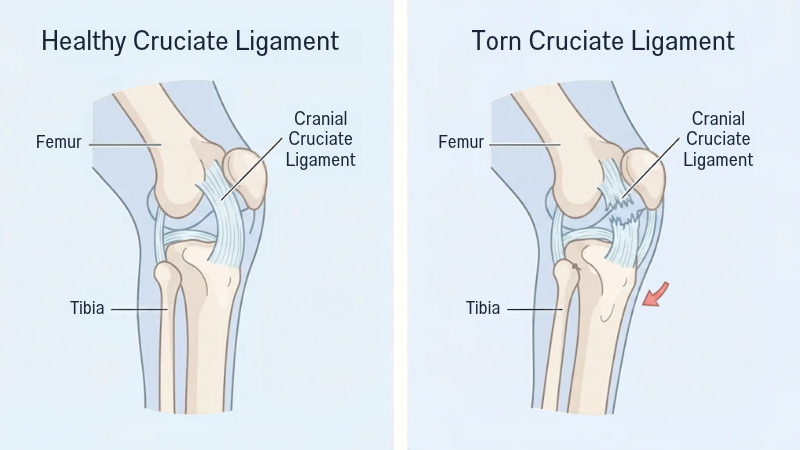
Finally, we stay alert for meniscal damage. Sitting like two tiny C-shaped rubber cushions between the thigh and shin bones are cartilage pads called menisci; surgical studies reported by the American College of Veterinary Surgeons (ACVS) show that roughly half (up to 48%) of dogs with a ruptured cruciate ligament also bruise or tear their inner (medial) meniscus, which is carefully inspected and treated during surgery.
Understanding what is happening inside that joint also makes it clear why simply hoping a torn cruciate ligament will “walk itself off” carries real drawbacks.
What Happens If a Torn Cruciate Ligament Is Left Untreated?
After an acute tear, a dog’s dramatic limp will sometimes seem to settle slightly after a fortnight of quiet rest around the house, tempting families to hope a simple sprain has healed. Sadly, without targeted care, the mechanical instability inside the knee remains active on every stride:
- Ongoing knee instability: Every time your dog puts weight on the leg, the thigh bone continues to slide down the sloped top of the shin bone.
- Continued pain and recurring lameness: That shearing motion repeatedly irritates the sensitive joint lining, keeping low-grade soreness smouldering beneath the surface.
- Secondary meniscal tearing: Without a working ligament holding the bones steady, the thigh bone crushes the back edge of the medial meniscus cushion, triggering sudden flare-ups of sharp pain.
- Accelerated osteoarthritis: Unstable joints lay down rough new bone and wear away smooth cartilage rapidly, speeding up lifelong joint stiffness.
- Muscle wastage and knock-on strain: As your dog avoids pushing off through the sore knee, their thigh muscles shrink and extra load shifts onto their spine, shoulders, and opposite back leg.
The reassuring news is that modern veterinary medicine gives us dependable ways to break this cycle of instability and get your dog moving comfortably again.
How Are Cruciate Ligament Injuries Treated in Dogs?
There is never a rigid, one-size-fits-all plan; we tailor treatment around relieving pain, restoring functional stability, and choosing an approach that genuinely works for your dog and whoever is caring for them at home. Broadly, management falls into non-surgical (conservative) care and surgical stabilisation:
- Rest and restricted activity: Conservative care requires 6 to 8 weeks of strict confinement—no stairs, jumping, or off-lead running, with short lead-only toilet breaks—allowing fibrous scar tissue to thicken around the knee.
- Veterinary-prescribed pain relief: Dog-specific anti-inflammatory and pain-relieving medications calm joint inflammation so your pet can rest and move comfortably.
- Weight management: Trimming even modest excess weight dramatically lowers the downward shearing force passing through the stifle on every step.
- Physiotherapy and rehabilitation: Guided home exercises, laser therapy, or underwater treadmill hydrotherapy rebuild wasted thigh muscles that help brace the knee.
- Surgical treatment: Operations that remodel the knee’s bone geometry or place a strong stabilising suture directly restore mechanical stability for confident weight-bearing.
While you are arranging transport or waiting for your clinic appointment, it is completely natural to want to ease your dog’s discomfort straight away—which brings us to one of the most important questions I ask every owner over the phone.
Can You Give Your Dog Aspirin or Other Human Painkillers for a Limp?
Whenever a family calls about a limping dog, I always check whether anyone at home has offered a tablet from their own medicine cabinet. Please never give your dog aspirin, ibuprofen, naproxen, or household paracetamol unless a vet has explicitly prescribed and dosed it for your individual pet. As warned by the UK’s Veterinary Poisons Information Service (VPIS) and explained in our guide on safe pain management in dogs, everyday human anti-inflammatories can cause severe stomach ulcers, internal bleeding, and acute kidney or liver failure in dogs.
Even a single dose of household aspirin creates a frustrating knock-on problem: it clashes dangerously with safer veterinary anti-inflammatories, forcing your vet to wait several “washout” days before starting optimal pain relief. Always hold off and let your vet prescribe dog-safe medication tailored to your pet’s exact weight and health.
Once your dog’s soreness is safely under control and we have confirmed a cruciate tear in the clinic, the biggest question on almost every owner’s mind is whether an operation is truly essential.
Does Your Dog Need Surgery for a Torn Cruciate Ligament?
Across UK primary-care practices, VetCompass research found that 68.4% of dogs diagnosed with cruciate rupture are treated surgically, while 23.9% are managed non-surgically. Veterinary orthopaedic specialists—including the ACVS—generally recommend surgery as the most reliable treatment because it is the only way to permanently neutralise mechanical instability inside the stifle.
Surgery is strongly advised for medium, large, and giant breeds (particularly dogs over 15 kg), energetic younger dogs, complete ruptures, and any knee with a painful meniscal tear. By contrast, structured non-surgical care can work well for small dogs under 10 to 15 kg, calm older dogs whose heart, liver, or kidney health makes general anaesthesia higher risk, or mild, stable early partial tears.
Can a heavier dog ever cope without an operation? In a landmark one-year clinical trial published in the Journal of the American Veterinary Medical Association (JAVMA), overweight dogs treated with TPLO surgery alongside rehabilitation achieved consistently higher success rates, though nearly two-thirds of strictly managed non-surgical dogs still reached acceptable everyday comfort through dedicated weight loss and physiotherapy.
When talking options through together, we weigh up your dog’s bodyweight, temperament, anaesthetic fitness, realistic budget, and the practical day-to-day support available at home so your family feels confident in the decision. If surgery is the right route, demystifying the main techniques takes a lot of worry out of operation day.
What Types of Cruciate Ligament Surgery Are Available for Dogs?
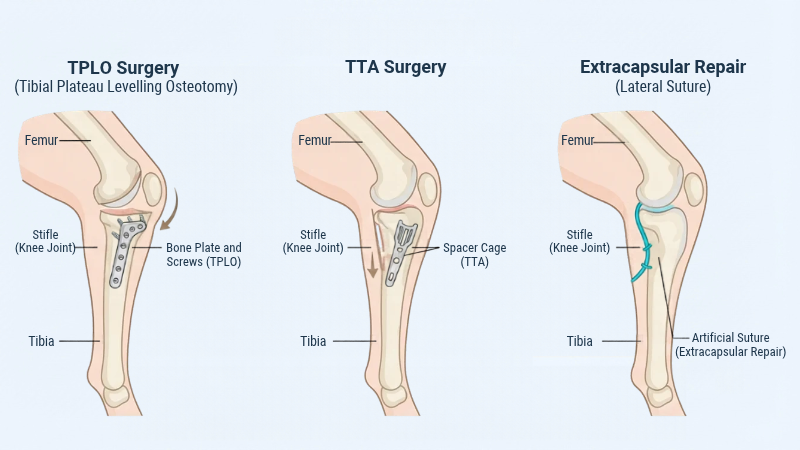
Unlike human ACL reconstruction—where surgeons typically graft a new tissue band inside the knee—internal grafts in dogs rarely withstand that constant sloped shin-bone force. Instead, veterinary surgeons rely on proven bone-remodelling (osteotomy) techniques or external suture repairs, whose strong clinical outcomes across Britain are tracked by initiatives like the RCVS Knowledge Canine Cruciate Registry.
What Is TPLO Surgery in Dogs?
Tibial Plateau Levelling Osteotomy (TPLO) is widely regarded as the gold-standard procedure for medium, large, and active dogs—and is equally effective in smaller breeds with steep shin-bone angles. Rather than replacing the torn ligament, TPLO changes the mechanics of the knee so the ligament is no longer needed to keep the joint stable.
While your dog is sleeping comfortably under general anaesthesia (you can read more about how we prepare dogs safely for anaesthesia and surgery), the surgeon makes a precise curved cut at the top of the shin bone, rotates that sloped surface until it sits nearly flat, and secures it with a medical-grade bone plate and screws. With the slope levelled out, the thigh bone stops sliding backwards when your dog stands, allowing early, stable weight-bearing.
What Is TTA Surgery in Dogs?
Tibial Tuberosity Advancement (TTA) achieves a similar biomechanical result through a slightly different bone cut. The surgeon makes a straight cut along the front crest of the shin bone—where the strong kneecap (patellar) tendon attaches—and shifts that crest slightly forward using a lightweight titanium spacer cage and plate.
Advancing that attachment redirects the pull of your dog’s powerful thigh muscles to roughly 90 degrees against the shin bone, cancelling out forward slip whenever your dog steps down. Like TPLO, TTA requires specialist orthopaedic instrumentation and roughly 8 to 12 weeks for the bone to heal solid.
What Is Extracapsular Repair in Dogs?
Often called a lateral suture or DeAngelis repair, extracapsular stabilisation does not involve cutting bone. Instead, a heavy-duty medical suture is anchored just outside the joint capsule along the exact line of the original cruciate ligament.
This strong synthetic band holds the shin bone steady during the first few months while your dog’s body builds firm, permanent scar tissue around the knee. Because heavier bodyweights can stretch or snap a suture before scar tissue matures, extracapsular repair is best suited to smaller dogs—typically under 15 kg—offering dependable results at a lower surgical cost.
Understanding how these procedures work leads naturally to another practical question every caring household needs clear answers on: planning for the cost of care.
How Much Does Cruciate Ligament Surgery Cost for Dogs in the UK?
Orthopaedic surgery is a meaningful financial commitment, and open, honest conversations about pricing should never feel uncomfortable. As we share in our transparent guide to pet surgery costs in the UK, fees depend on your dog’s bodyweight (larger patients require more anaesthetic, fluids, and larger implants), the surgical method chosen, and whether you visit an independent practice or a specialist referral centre:
- Consultations and diagnostics: An initial vet check typically costs £50 to £80 (£62 at our Southampton clinic), while sedated orthopaedic X-rays and pre-anaesthetic blood tests usually range from £350 to £750.
- Extracapsular (lateral suture) surgery: Generally ranges from £1,200 to £2,200 across UK clinics, providing a reliable, accessible option for smaller dogs.
- TPLO and TTA surgery: UK referral centres average around £3,950, with specialist hospitals frequently quoting £3,900 to £4,750+ depending on complexity and bodyweight.
- Aftercare and rehabilitation: Factor in any extra medication top-ups, follow-up X-rays (if not bundled into a fixed package), and optional hydrotherapy or physiotherapy at roughly £35 to £65 per session.
Independent practices equipped for advanced orthopaedics often help bridge that cost gap for local families—for instance, TPLO surgery at Bluebell Veterinary Surgery is priced at £2,980, including hospital pain relief, intravenous fluids, and post-operative X-rays.
If your dog is insured, check your policy documents early. Most lifetime policies cover cruciate treatment provided the limp began after the initial waiting period and wasn’t noted beforehand as a pre-existing issue. Keep an eye out for bilateral clauses, too: some insurers class cruciate disease in both back knees as one linked condition, meaning both legs share a single claim pot rather than separate allowances.
Once surgery is behind you and the practicalities are settled, the spotlight shifts to the part where calm family teamwork at home truly shines—guiding your dog smoothly through recovery.
What Should You Expect During Your Dog’s Recovery After Cruciate Ligament Surgery?
Even the neatest orthopaedic operation is only half the journey; quiet, structured home care is what protects healing bones and implants while your dog regains confidence. Whether you are overseeing recovery yourself or coordinating daily routines with family members at home, knowing what each stage looks like keeps everyone relaxed and prepared.
What Happens During the First Few Days After Surgery?
Straight after surgery, your dog wakes up in a warm, peaceful ward under attentive nursing care, with tailored pain relief and local nerve blocks keeping the operated leg comfortable. Once bright and steady on their paws, they head home—usually the same evening or the following day—feeling understandably sleepy from the anaesthetic.
Prepare a cosy, draught-free ground-floor space beforehand with supportive orthopaedic bedding and fresh water close by. Don’t be alarmed if their appetite is slightly modest on the first evening or if it takes a couple of days to pass a normal motion; gentle company and a quiet room will help them settle right back in.
How Should You Care for Your Dog After Surgery?
Sticking to simple, consistent daily habits across the first fortnight prevents almost every common post-operative hiccup:
- Wound protection: Check the incision daily for excess heat, redness, or discharge, and keep their protective Buster collar on whenever unsupervised for 10 to 14 days—even brief licking can introduce infection.
- On-time medication: Give all prescribed anti-inflammatories and painkillers strictly on schedule, even when your dog starts looking bright and eager to potter about.
- Strict room or crate rest: Keep your dog safely settled inside a recovery crate, sturdy pen, or small ground-floor room whenever someone isn’t sitting directly beside them.
- Lead-only toilet trips and non-slip floors: Restrict garden breaks to 5 minutes on a short lead, block off stairs and sofas, and lay non-slip mats or carpet runners across wood, laminate, or tiled floors.
Following those calm house rules sets your dog up brilliantly for the steady rehabilitation milestones ahead.
How Long Does It Take for a Dog to Recover From Cruciate Ligament Surgery?
Bone and soft-tissue healing typically takes 8 to 12 weeks, with full muscular strength and stamina returning around the 3-to-4-month mark:
- Weeks 1 to 2: The skin incision heals, external stitches (if used) are checked or removed, and most dogs begin lightly touching their toes to the floor.
- Weeks 3 to 6: Lead walks build up gradually—adding just 5 controlled minutes per week on flat pavements as guided by your vet—alongside gentle home weight-shifting exercises.
- Weeks 6 to 8: Follow-up X-rays (for TPLO or TTA patients) confirm that the bone cut has bridged smoothly around the surgical plate.
- Weeks 8 to 12 and beyond: Guided physiotherapy or underwater treadmill hydrotherapy rebuilds even thigh muscle without joint impact, leading into a phased return to off-lead walks once signed off.
As your dog gets their bounce back on the repaired leg, there is one long-term pattern we always keep a friendly, watchful eye on together.
Can a Dog Develop a Cruciate Ligament Injury in Both Back Legs?
Yes, and knowing about this early helps you feel prepared rather than caught off guard. Orthopaedic data from the ACVS shows that 40% to 60% of dogs affected in one knee will develop cruciate disease in their opposite back knee at some stage later in life.
Why is the second knee vulnerable? Because the inherited shin-bone slope and natural collagen wear affect both hind legs equally, and leaning extra weight onto the “good” leg while limping adds extra strain. Watching for early signs like morning stiffness or crooked sitting on the unoperated side—alongside keeping your dog trim—gives that remaining ligament its best possible protection.
Those exact same everyday habits are also your strongest defence for protecting healthy knees from day one.
How Can You Help Prevent Cruciate Ligament Injuries in Dogs?
While none of us can alter a dog’s genetics or natural knee angles, thoughtful daily care dramatically lowers everyday wear and tear across their joints:
- Maintain a lean body weight: Follow the body-condition checks in the WSAVA Global Nutrition Guidelines—you should feel your dog’s ribs easily under a light covering and see a clear waist from above.
- Provide steady, regular exercise: Consistent daily walks keep the thigh and core muscles around the stifle strong, balanced, and supportive.
- Build fitness gradually: After a quiet winter or a rest break, build walking distance and hill climbs back up gently over several weeks rather than in one big weekend hike.
- Avoid sudden high-impact twisting: Swap frantic, skidding ball-launcher sprints and sharp mid-air leaps for controlled fetch, scent-work games, or swimming.
- Support lifelong joint health: Chat with your vet about whether evidence-based omega-3 fatty acids or joint supplements suit your dog’s age and breed.
- Keep up regular check-ups: Routine health visits—a cornerstone of preventative pet care in the UK—let your vet catch subtle stiffness or gradual weight creep early.
To clear up any lingering questions you may still be mulling over at home, here are straightforward answers to the queries dog owners ask me most often in the consult room.
Frequently Asked Questions
Can a Dog Live a Normal Life After Cruciate Ligament Surgery?
Absolutely—the vast majority of dogs go back to living comfortable, active, happy lives once they have healed from cruciate surgery and completed their rehabilitation. While mild age-related joint stiffness can occasionally creep in during their senior years, most patients return wholeheartedly to enjoying country walks, pottering happily in the garden, and joining in with everyday family life.
How Long Does a Dog Take to Recover From Cruciate Ligament Surgery?
Most dogs need around 8 to 12 weeks for initial bone or tissue healing following procedures such as TPLO, TTA, or extracapsular repair. Rebuilding symmetrical thigh muscle and working back up to normal off-lead stamina usually takes around 3 to 4 months in total, depending on the surgical technique used, your dog’s overall fitness, and how closely those calm home-rest rules are followed.
How Much Does Cruciate Ligament Surgery Cost for Dogs in the UK?
Surgical fees depend on your dog’s bodyweight, the procedure chosen, and whether the operation takes place at an independent practice or a specialist referral hospital. Across the UK, prices generally start around £1,200 for an extracapsular repair in a smaller dog and can reach £4,000 or more for TPLO or TTA at referral centres, with independent orthopaedic-equipped clinics often sitting noticeably lower. Always ask your vet for a clear, itemised estimate upfront so you know how surgery, pain relief, and follow-up X-rays are covered.
Can a Dog Recover From a Torn Cruciate Ligament Without Surgery?
Some dogs—particularly calm, smaller breeds under 15 kg or pets with mild early partial tears—can cope well with strict room rest, veterinary-prescribed pain relief, weight management, and guided physiotherapy. However, conservative care cannot knit a torn ligament back together, meaning medium, large, and energetic dogs almost always achieve much steadier, longer-lasting comfort through surgical stabilisation. A thorough knee examination with your vet will help you choose the right path for your dog.
Will My Dog Need Cruciate Ligament Surgery on Both Back Legs?
Not necessarily—around half of affected dogs never need an operation on their second leg. Because inherited knee shape and natural ligament wear mean 40% to 60% of dogs can eventually develop cruciate trouble on the opposite side, keeping your dog lean, building fitness steadily with controlled daily walks, and getting any new stiffness checked early gives that remaining knee its strongest protection.
Helping Your Dog Walk Comfortably Again
Seeing a much-loved dog hobble—especially when they quietly step back from the everyday garden games and family moments they usually cherish, whether you are caring for them at home yourself or worrying from afar like that devoted teenager and his grandmother—always tugs at your heartstrings. Please remember that you never have to puzzle out the cause alone, and a cruciate ligament diagnosis is very far from the end of your dog’s happy, active adventures.
With a calm hands-on examination, dog-safe pain relief, and a treatment plan tailored around both your pet and your household—whether through structured conservative care or modern orthopaedic surgery—dogs recover remarkably well and soon get their bounce back. If you have spotted a new limp or stiffness in your dog and live near Bursledon or the wider Hampshire area, feel free to get in touch with our friendly team in Southampton for an unhurried examination and honest, reassuring advice tailored to your pet.

Is Your Dog Limping? Find Out If Cranial Cruciate Ligament Surgery Can Help
November 20, 2026
How Is Pancreatitis in Dogs Treated, and Does It Require Surgery?
November 10, 2026
What Happens During Dog Tumor Removal Surgery?
November 6, 2026